Published: 23 November 2026 · Last updated: 23 November 2026 · By Ameer Hamza
A three-person startup hiring in Colorado, Maryland, Virginia, Connecticut or Washington, DC already has to put pay in its job ads. At 15 employees that list grows to 12 jurisdictions, and at 50 it covers every US state with a pay transparency law in force. Pay transparency used to be a big-company problem. In 2026 it isn't.
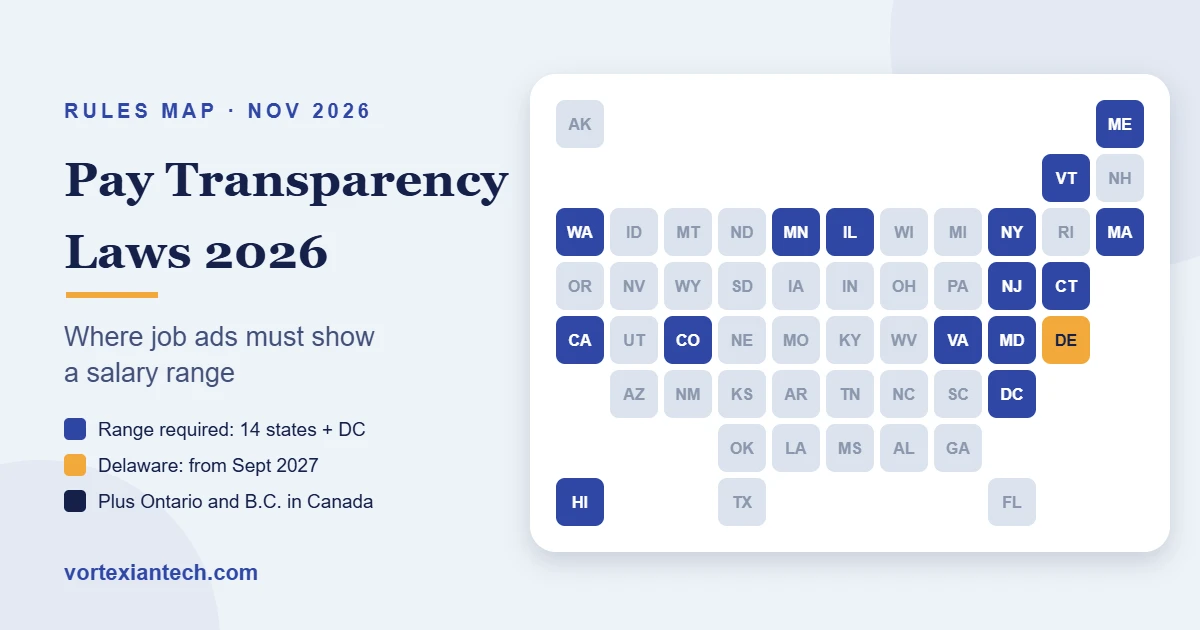
Quick answer: As of November 2026, 14 US states and Washington, DC require pay information in job ads, and Delaware joins in September 2027. In Canada, Ontario and British Columbia have similar rules. The UK and Australia don't require pay in adverts, but both have other pay transparency duties. If one ad can be answered from several places, post a real range.
US Pay Range Laws, State by State
Each row is based on official state sources, linked at the end. "Benefits too?" means the ad must also describe benefits, and in most of those states other pay such as bonuses or commission.
Place | Who is covered | Each ad must show | Benefits too? | Since |
|---|---|---|---|---|
Colorado | Any employer with staff in Colorado | Hourly or salary pay, or a range | Yes | Jan 2021 |
California | 15+ employees, at least one in California | A good-faith salary or hourly pay scale | No | 2023 |
Washington | 15+ employees | Wage scale or salary range | Yes | 2023 |
New York | 4+ employees | Pay range, plus the job description | No | Sept 2023 |
Hawaii | 50+ employees | Hourly rate or salary range | No | Jan 2024 |
Washington, DC | All employers with DC staff | Minimum and maximum pay | Healthcare benefits before the first interview | 2024 |
Maryland | All employers | Wage range, or the exact rate | Yes | Oct 2024 |
Illinois | 15+ employees, counted everywhere | Pay scale | Yes | Jan 2025 |
Minnesota | 30+ employees in Minnesota | Starting salary range or a fixed rate; no open-ended ranges | Yes | Jan 2025 |
New Jersey | 10+ employees over 20 weeks | Hourly wage or salary, or a range | Yes | June 2025 |
Vermont | 5+ employees | Pay or a pay range; special wording for tipped and commission jobs | No | July 2025 |
Massachusetts | 25+ employees | Annual salary or hourly wage range | No | Oct 2025 |
Virginia | All employers | Wage or salary, or a range, in public and internal postings | No | July 2026 |
Maine | 10+ employees | Anticipated pay range | No | July 2026 |
Connecticut | All employers | Wage range in public and internal postings | Yes | Oct 2026 |
Delaware (coming) | More than 25 employees | Pay range | Yes | Sept 2027 |
Some cities, such as New York City, add rules of their own on top.
How Many Laws Apply to a Company Your Size?
Headcount thresholds are where most employers get caught out. This is our count from the table above, for a job based in each place:
Your headcount | Places where the ad needs pay | Added at this size |
|---|---|---|
1 to 3 | 5 | Colorado, Connecticut, DC, Maryland, Virginia |
4 | 6 | New York |
5 to 9 | 7 | Vermont |
10 to 14 | 9 | Maine, New Jersey |
15 to 24 | 12 | California, Illinois, Washington |
25 to 29 | 13 | Massachusetts |
30 to 49 | 14 | Minnesota |
50 or more | 15 | Hawaii |
Each state counts staff its own way. Minnesota counts only employees at Minnesota sites and Massachusetts counts staff whose main workplace is in Massachusetts, while Illinois counts every employee, wherever they work. Delaware adds employers with more than 25 staff from September 2027. If you are crossing these thresholds, our headcount decision tree shows which other US employment laws start at 15, 20, 50 and 100 staff.
Remote Job Ads: Which Law Applies?
Most of these laws follow the job, not the head office. New York and Illinois cover roles done at least partly in the state, including remote roles that report to a supervisor, office or work site there. Maryland covers a remote role at an out-of-state company if the work will be done partly in Maryland, and Vermont covers remote roles that mainly work for a Vermont office. British Columbia goes further and covers jobs advertised outside the province if B.C. residents can do them remotely.
So a single "remote, anywhere" advert usually has to meet several laws at once. The simple fix is a real range in every remote ad.
Canada, the UK and Australia
Place | What the rule says | Since |
|---|---|---|
Ontario | Employers with 25 or more employees must show expected pay or a range in publicly advertised postings. The range can't be wider than $50,000 a year, and no pay is needed if it tops $200,000. Ads must also say whether the vacancy exists now and whether AI screens applicants, and can't ask for Canadian experience. | 1 Jan 2026 |
British Columbia | All provincially regulated employers must post expected pay or a specific range. "Competitive wage", "up to $30 per hour" and "$20 per hour and up" don't count. Most employers with 50 or more employees must also publish pay transparency reports by November 2026. | 1 Nov 2023 |
United Kingdom | No general legal duty to show pay in adverts. Employers with 250 or more employees must publish gender pay gap figures every year. | — |
Australia | No rule on pay in job ads. Pay secrecy terms can't go into contracts made or changed from 7 December 2022, and employees can share or ask about pay. | 7 Dec 2022 |
Ontario's rules don't apply to postings open only to existing staff or to general "help wanted" signs. Elsewhere in Canada, check the province before you post.
Six Posting Mistakes That Break These Rules
An open-ended range. "$60,000+" or "up to $30 an hour" fails in Minnesota, which bans open-ended ranges, in Illinois, which expects a bounded range, and in British Columbia.
"Competitive salary". It isn't a number, so it fails everywhere on this map.
Hiding the range behind a link or QR code. California says a link or QR code doesn't count. Maryland accepts a link only if it holds everything the ad must show. Put the range in the ad itself.
Forgetting internal postings. Virginia and Connecticut cover internal postings, New York and New Jersey cover transfers, and Illinois employers who post a job externally must tell current staff about it within 14 days.
A job board or recruiter dropping the range. California makes the employer give the pay scale to any third party that posts for it, Maine counts postings made through third parties, and British Columbia covers job boards and recruitment platforms.
A range nobody would really pay. California, Massachusetts and Minnesota all describe the range as a good-faith estimate of what you expect to pay, and Ontario caps its width at $50,000.
How to Set a Range You Can Defend
Define the job first. Level, location and must-have skills decide the number, so settle them before you price the role. Our job description rewrite shows how.
Pull official pay data for the occupation and area. In the US, the BLS Occupational Employment and Wage Statistics program publishes wage estimates for about 830 occupations (latest: May 2025). Canada's Job Bank compares wages by occupation and region, the ONS Annual Survey of Hours and Earnings covers the UK (2026, provisional), and the ABS Employee Earnings and Hours survey covers Australia (May 2025).
Check what you already pay. The new range has to sit sensibly next to current staff in the same role, especially where employees can ask for their own range, as in California, Massachusetts and Maine.
Set a minimum and maximum you would really pay. Keep it tight enough to mean something, and make the offer letter match it. Our hiring email templates include an offer email you can adapt.
Write down how you got there. Maryland expects compliance records to be kept for at least three years, and Maine requires pay history records for three years after an employee leaves.
Short on time? Our compensation and salary benchmarking team builds role-by-role benchmarks, pay bands and pay transparency support for your job ads. Ask at info@vortexiantech.com.
Pay Range Questions Employers Ask
Do remote job ads need a salary range?
Often, yes. New York and Illinois cover remote roles that report to an office or supervisor in the state, Maryland covers remote work done partly in Maryland, and British Columbia covers remote jobs B.C. residents can fill. If one ad reaches several states, post a range.
Can a pay range be open-ended, like "$60,000+"?
No. Minnesota says a salary range may not be open ended, Illinois expects a bounded range, and British Columbia rejects "up to" and "and up" wording. Give a real minimum and maximum.
Can I offer more than the posted range?
Where the rules address it, yes. Ontario says disclosing a range doesn't oblige you to offer that pay to any applicant, and British Columbia lets candidates ask for, and employers offer, pay outside the range. The range must still be a good-faith estimate when you post it.
Does a recruitment agency's job ad have to show pay?
Yes. California requires the employer to give the pay scale to any third party that posts for it, Maine counts postings made through third parties, and British Columbia covers ads on job boards and recruitment platforms.
What happens if a job ad leaves out the range?
Penalties vary. Virginia allows civil penalties of up to $1,000 for a first violation and $5,000 after that, and Washington, DC fines start at $1,000 and reach $20,000 for repeat violations. Some states give you time to fix it first: 5 business days after notice in Washington State and 15 business days in Virginia.
This map reflects official sources checked in November 2026. It is general information, not legal advice. Laws and thresholds change, so confirm the rules for each place you hire before you post.
Where These Rules Come From
US states and DC: Colorado SB19-085 · California Equal Pay Act FAQ · Washington Equal Pay and Opportunities Act · New York pay transparency · Hawaii Act 203 FAQs · DC wage transparency advisory · Maryland wage range transparency FAQ · Illinois pay transparency FAQ · Minnesota Statutes 181.173 · New Jersey pay transparency · Vermont 21 V.S.A. § 495p · Pay transparency in Massachusetts · Virginia DOLI July 2026 law updates · Virginia Code § 40.1-28.7:12 · Maine labor law changes, July 2026 · Connecticut Public Act 26-12 announcement · Delaware HS 2 for HB 105
Canada: Ontario publicly advertised job postings · B.C. pay information on job postings · B.C. job posting rule start date · Pay transparency in B.C.
United Kingdom: Gender pay gap reporting overview
Australia: Fair Work Ombudsman: pay secrecy
Pay data: BLS Occupational Employment and Wage Statistics · Job Bank wage search · ONS Annual Survey of Hours and Earnings · ABS Employee Earnings and Hours
Post Every Job With a Range That Holds Up
Vortexian Tech's compensation and salary benchmarking service covers salary benchmarking by role, pay bands and structures, a benefits review and pay transparency support, with packages from $1,800 one-time. When you're ready to hire, our recruitment team writes the role brief and job advert with the range already in it, and our remote and international recruitment team hires across time zones.
Tell us the roles and where you hire at info@vortexiantech.com, or book a call.