Published: 12 November 2026 · Last updated: 12 November 2026 · By Ameer Hamza
Most founders ask "when do I need HR?" a little too late, usually the week a manager asks how to handle a complaint, or an employee asks about leave nobody knew they were entitled to. The honest answer is not one number. Several US federal laws switch on at different headcounts, and each one changes what your HR has to do.
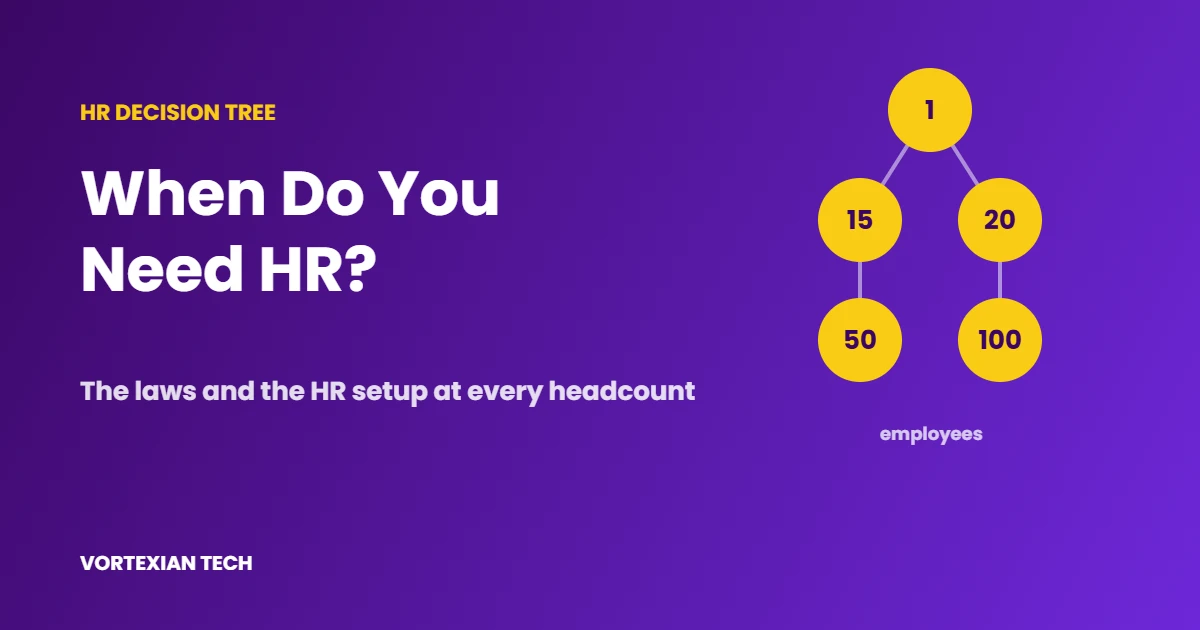
The short version: you need someone responsible for HR from your first employee. You need written policies and a trained manager by about 15 employees, when the main anti-discrimination laws apply. You need real HR capacity, outsourced or in-house, by 50, when family leave and the health-coverage rules start. At 100, reporting and layoff-notice rules make dedicated HR almost unavoidable.
Use the tree below. Start at question 1 and stop at the first "no".
The decision tree
Question 1: Do you pay at least one employee (not a contractor)?
No → You don't need HR yet, but check that your contractors really are contractors. If you set their hours, tools and methods, they may count as employees.
Yes → From employee number one you have to check work eligibility for every new hire (Form I-9), run payroll and withhold taxes correctly, and follow federal wage and hour rules. What you need: one named person who owns hiring paperwork and payroll, plus a reliable payroll process. Go to question 2.
Question 2: Have you had 15 or more employees for 20 weeks this year or last year?
No → The big federal anti-discrimination laws may not cover you yet, although state and local laws often start lower. Keep fair, written hiring steps anyway; it is far easier to build the habit now.
Yes → Title VII and the ADA now apply. You must not discriminate in hiring, pay, promotion or firing, must prevent harassment, and must consider reasonable accommodations for disability. Part-time and temporary staff count toward the 15. What you need: an employee handbook with an anti-harassment and complaints policy, a written hiring process, and managers who know how to respond to a complaint. This is the point where most small companies bring in an HR consultant for a policy set-up. Go to question 3.
Question 3: Have you reached 20 employees?
Yes → The federal age discrimination law (protecting workers 40 and over) applies, and if you offer a group health plan, COBRA continuation coverage applies once you had 20 or more employees in the prior year. What you need: a benefits process that sends the right notices when someone leaves, and age-neutral wording in job ads. Go to question 4.
Question 4: Do you have 50 or more employees?
Two different rules switch on around 50, and they count people differently.
- Family and Medical Leave Act (FMLA): covers private employers with 50 or more employees in 20 or more workweeks in the current or previous year. Eligible staff can take job-protected leave.
- Affordable Care Act employer rules: you are an "applicable large employer" if you averaged at least 50 full-time employees, including full-time equivalents, in the previous year. Full-time means 30 hours a week or 130 hours a month, and part-timers' hours are combined into equivalents.
Worked example from the IRS method: 40 full-time staff plus 20 part-timers working 60 hours a month each gives 10 full-time equivalents (20 × 60 ÷ 120), so the company counts as 50 and is an applicable large employer.
What you need: leave tracking, health-coverage decisions and reporting, and someone who can run them every month. Many companies at this size either outsource HR administration and payroll or hire their first HR generalist. Go to question 5.
Between 15 and 50 and not sure what you're missing? Send us your headcount and the states you hire in. We'll reply with the gaps we'd fix first. info@vortexiantech.com
Question 5: Do you have 100 or more employees?
Yes → Two more rules apply. Private employers with 100 or more employees must file the annual EEO-1 workforce report with the EEOC. And the WARN Act generally requires 60 calendar days' written notice before a plant closing or mass layoff. What you need: an HR function with reporting, workforce planning and legal review built in. At this size the question is usually how big the HR team should be, not whether to have one.
The thresholds on one page
| Headcount | What starts | Typical HR set-up |
|---|---|---|
| 1+ | Form I-9, payroll tax, federal wage and hour rules | Owner or office manager + payroll process |
| 15+ | Title VII, ADA (anti-discrimination, accommodation) | Handbook, complaint process, HR consultant on call |
| 20+ | Age Discrimination in Employment Act; COBRA (if you have a group health plan) | Benefits and exit notices process |
| 50+ | FMLA; ACA applicable large employer rules | Outsourced HR admin or first HR hire |
| 100+ | EEO-1 report; WARN Act notices | Dedicated HR team |
Federal thresholds only. Many states and cities have lower thresholds or extra rules, so check where your staff work. This is general information, not legal advice.
Consultant, outsourced or in-house: how to choose
An HR consultant fits when you need a project done well once: a handbook, a pay structure, a performance system or a messy investigation. You pay for the project, not a salary. See our HR consultant cost guide for typical fees.
Outsourced HR and payroll fits when the work is ongoing but not big enough for a full-time person: monthly payroll, leave tracking, onboarding paperwork, compliance checks. Our payroll outsourcing plan shows how a handover works.
An in-house HR hire fits when people issues take up real time every week, usually somewhere between 50 and 100 employees. Even then, many companies keep payroll or recruitment outsourced so the first HR hire can focus on people, not admin.
Already have a handbook? Check it against our employee handbook checklist, and make sure your onboarding checklist covers the day-one paperwork.
Short answers
At what size does a company need HR?
Someone must own HR tasks from the first employee. Written policies matter by about 15 employees, outsourced or in-house HR support by about 50, and a dedicated HR team by about 100.
Do part-time employees count toward these thresholds?
For the EEOC laws, yes: part-time, seasonal and temporary employees all count. For the ACA, part-timers are combined into full-time equivalents. Independent contractors and owners are not counted.
Can a small business outsource all of its HR?
Most of it, yes: payroll, onboarding paperwork, policies and compliance checks can all be outsourced. The business still makes the employment decisions and stays responsible for following the law.
Do these rules apply outside the US?
No. They are US federal rules. Other countries have their own, often with lower or no headcount thresholds.
Where these thresholds come from
- EEOC: How do you count the number of employees an employer has?
- EEOC: Small business information
- EEOC: EEO data collections (EEO-1)
- US Department of Labor: Family and Medical Leave Act
- US Department of Labor: COBRA continuation coverage
- US Department of Labor: Plant closings and layoffs (WARN)
- IRS: Determining if an employer is an applicable large employer
Get the right amount of HR, not more
Tell us your headcount, where your people work and what is taking up your time. We'll recommend the smallest set-up that covers you. Our HR and engagement packages are $1,800, $3,500 and $5,350, and we also offer HR compliance reviews and payroll management on a written quote.
Email info@vortexiantech.com or request a free quote.