Published: 18 November 2026 · Last updated: 18 November 2026 · By Ameer Hamza
Most hiring email templates are written to sound friendly. Few are written to be read twice: once by the candidate today, and again by a lawyer or an investigator a year from now. A rejection that mentions "energy", an offer that promises a "permanent" job, or a first-day email that asks for a passport can turn a polite message into evidence.
Below are six emails for the path from interview to day one, each with its timing, the reason for every line and the one legal tripwire to avoid. Copy them, fill in the brackets and keep the notes.
The Pack at a Glance
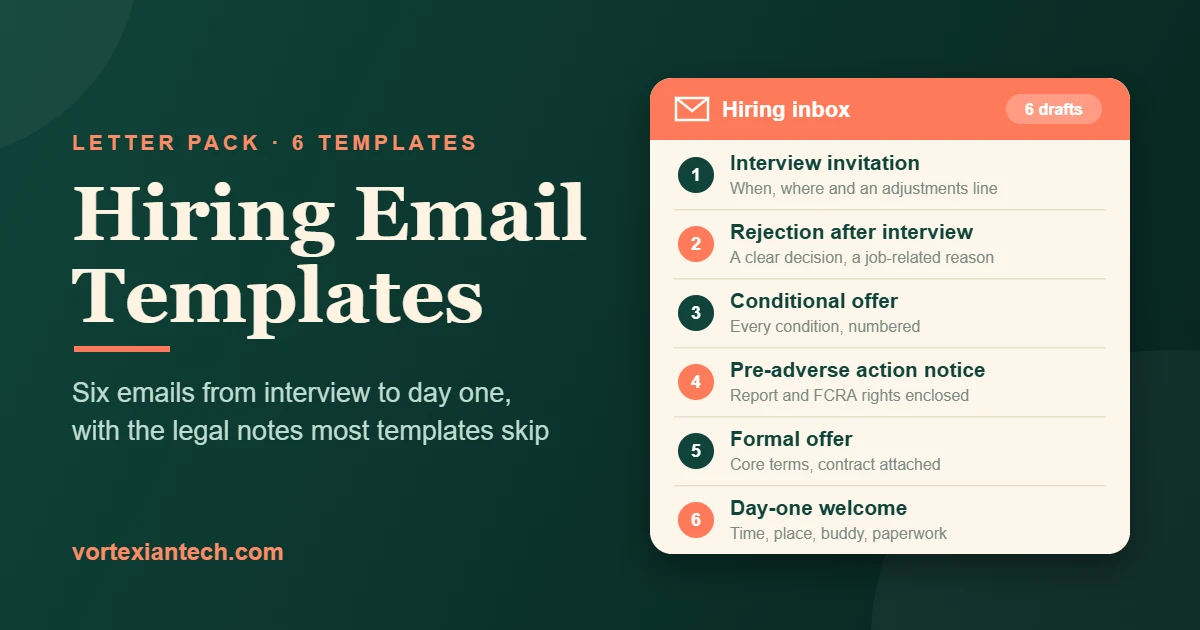
Hiring email templates are ready-made messages for each step of the hiring process. A complete set covers six moments: the interview invitation, the rejection, the conditional offer, the US pre-adverse action notice, the formal offer and the day-one welcome. Sending each at a fixed point keeps candidates informed and decisions on record.
# | When to send it | What it must get right | |
|---|---|---|---|
1 | Interview invitation | As soon as the slot is agreed | The same adjustments line for every candidate |
2 | Rejection after interview | Within days of the decision | A job-related reason, or no reason |
3 | Conditional offer | When you pick your candidate, before checks finish | Every condition listed; check consent on a separate form |
4 | Pre-adverse action notice (US) | Before you withdraw an offer over a background report | The report and the FCRA summary of rights enclosed |
5 | Formal offer | Once every condition is cleared | Core terms in writing, no promise of job security |
6 | Day-one welcome | A few working days before the start date | The new hire chooses their ID documents |
Letter 1: The Interview Invitation
Send: as soon as the time is agreed · From: the recruiter or hiring manager · Subject line: Interview for [Job Title] at [Company], [Day, Date]
Hi [First name],
Thank you for applying for the [Job Title] role. We'd like to invite you to a [45]-minute [video / phone / in-person] interview with [Interviewer name], our [Interviewer's job title].
When: [Day, Date] at [Time and time zone]
Where: [Video link, or full address with entry and parking details]
What to expect: [Questions about your experience with X, then a 15-minute task on Y. You don't need to prepare anything else.]
If any adjustment would help you take part, such as extra time, a different format or step-free access, reply to this email and tell us what you need. We'll arrange it.
Please confirm by [Date]. If the time doesn't work, reply with two times that do.
[Name], [Job title], [Company], [Phone]
Why each line is there
Interviewer name, length and format let the candidate prepare, and stop anyone turning up at the wrong door or the wrong link.
The time zone matters once you interview across borders. Our remote and international recruitment team matches time zones before the first call.
"What to expect" gives every candidate the same preview, which supports a structured, fair interview.
The adjustments line makes it easy to ask. In the US, employers must provide an accommodation an applicant with a disability needs to apply or interview, unless it would cause significant difficulty or expense.
Tripwire: scheduling forms that ask for date of birth, nationality, health or family details. The EEOC's general rule: limit pre-employment questions to what is essential to judge whether someone is qualified.
Letter 2: The Rejection After an Interview
Send: within a few working days of your decision · From: someone the candidate met · Subject line: Your application for [Job Title]
Hi [First name],
Thank you for meeting [Interviewer name] on [Date], and for the time you put into the [task / interview].
We've now made our decision for the [Job Title] role, and we won't be moving forward with your application.
[Optional, job-related reason: We chose a candidate with more hands-on experience in (skill or tool named in the job description), which is a core part of this role.]
[Optional: Would you like us to keep your details for similar roles over the next (6) months? Just reply "yes".]
Thank you again, and good luck with your search.
[Name], [Job title]
Why each line is there
The date and the interviewer's name show the candidate this isn't a mass email.
The decision comes in the second paragraph, not after three lines of praise. Clear is kinder than vague.
A reason is optional. If you give one, tie it to a requirement written in the job description, and never to a protected trait. US federal law covers race, color, religion, sex (including pregnancy, transgender status and sexual orientation), national origin, age 40 or older, disability and genetic information. If your job descriptions are vague, fix them first: our job description rewrite shows how.
The talent-pool line asks for a yes instead of assuming one, so you only keep details people agreed to.
Tripwire: leaving people waiting. In Ontario, since 1 January 2026, employers with 25 or more employees must tell applicants they interviewed for a publicly advertised job whether a hiring decision has been made, within 45 days of the last interview. A dated rejection email covers it.
Letter 3: The Conditional Offer
Send: when you've chosen your candidate but checks are still running · From: the hiring manager · Subject line: Conditional offer: [Job Title] at [Company]
Hi [First name],
We're pleased to offer you the role of [Job Title], subject to the conditions below.
Proposed terms: [salary or hourly rate], paid [weekly / every two weeks / monthly]; [full-time / part-time], [hours]; based at [location / remote]; proposed start date [Date].
This offer depends on: (1) two satisfactory references; (2) a background check, for which we'll send a separate consent form; (3) proof of your right to work in [country].
We'll confirm in writing once these are complete. Please don't resign from your current job until you have that confirmation.
Please reply by [Date] to accept these conditions, or call me on [Phone] with any questions.
[Name], [Job title]
Why each line is there
Numbered conditions: a condition you didn't write down now is hard to rely on later.
"Don't resign yet" protects the candidate, and you, if a check comes back with a problem.
Criminal-history timing: some US states and cities only allow conviction questions after a job offer. California's Fair Chance Act, for example, generally bars employers with five or more employees from asking about conviction history before making an offer.
Tripwire: burying background-check consent in the offer email. Under the Fair Credit Reporting Act, before you get a background report from a screening company you must tell the candidate in writing, in a stand-alone document, and get their written permission. Our background check cost guide walks through the full FCRA timeline.
Hiring for several roles? Our recruitment team handles interview scheduling, preliminary interviews and offer support, and our candidate screening service adds structured interviews and skills tests. Ask at info@vortexiantech.com.
Letter 4: The Pre-Adverse Action Notice (US)
Send: before you withdraw an offer because of something in a background report · From: HR · Subject line: Your background check: please review before we decide
Dear [Full name],
As part of your conditional offer for [Job Title], we received a background report from [Screening company]. Information in that report may lead us to withdraw the offer.
Before we make a final decision, we have enclosed (1) a copy of the report we relied on and (2) "A Summary of Your Rights Under the Fair Credit Reporting Act".
If anything in the report is inaccurate or incomplete, or if you'd like to explain it, please contact me by [Date].
No final decision has been made.
[Name], [Job title], [Phone]
Why each line is there
The two enclosures are what the FTC says you must give before taking adverse action based on a background report.
A reply-by date: the FTC sets no waiting period, but the notice exists so the person can review the report and explain, so give a reasonable window and write the date.
"No final decision has been made" is true at this stage, and it keeps the conversation open.
Tripwire: sending the rejection together with the report. If you do decide not to hire, a second notice must follow. It has to say the decision was based on the report; give the screening company's name, address and phone number; say the company didn't make the decision and can't give specific reasons; and explain the candidate's right to dispute the report and to get an extra free copy within 60 days.
Letter 5: The Formal Offer
Send: once every condition is cleared · From: the hiring manager, with the contract attached · Subject line: Your offer: [Job Title], starting [Date]
Hi [First name],
Good news: all checks are complete, and we're delighted to confirm your offer as [Job Title], reporting to [Manager name].
Start date: [Date]
Pay: [amount] per [year / hour], paid [weekly / every two weeks / monthly]
Hours and place of work: [hours and days], at [address / remote]
Probation: [length and review point, if any]
Paid time off: [entitlement]
Your [contract / offer letter] is attached and sets out the full terms. If anything in this email differs from it, the attached document applies.
Please sign and return it by [Date]. I'm happy to talk through any questions before then.
[Name], [Job title]
Why each line is there
Five core terms in one block: the details new hires most often ask about, several of which must be in writing anyway (see the table below).
"The attached document applies" stops the email and the contract from becoming two competing versions.
A reply-by date keeps the offer from hanging open while your second-choice candidate accepts another job.
What Each Country Adds at the Offer Stage
Country | Rule to build into your offer process | Deadline |
|---|---|---|
United States | Form I-9: the new hire chooses which acceptable documents to present, and you can't specify them | Section 2 within 3 business days of the first day of work |
United Kingdom | Right to work check, then a written statement of employment particulars | Check before employment starts; principal statement on day one; wider statement within 2 months |
Canada (Ontario) | Employers with 25 or more employees give written details: legal name, contact details, work location, starting wage, pay period and pay day, initial hours | Before the first day, or as soon as reasonably possible |
Australia | Fair Work Information Statement, plus the casual or fixed-term statement where it applies | Before, or as soon as possible after, the start date |
Tripwire: promising job security you didn't mean to. In most US states employment is "at will", and words like "permanent", "guaranteed" or "secure" in an offer can be argued as a promise. Describe the role as full-time and let the contract set probation and notice.
Letter 6: The Day-One Welcome
Send: a few working days before the start date · From: the new hire's manager, not a no-reply address · Subject line: Your first day on [Date]: what to expect
Hi [First name],
We're looking forward to you joining us on [Date]. Here's everything you need for day one.
Arrive or log in: [Time], [address and who to ask for / video link]
Your first day: [welcome with me at 9:30, laptop and account set-up, team lunch, first project briefing]
Your buddy: [Name, role], for all the small questions
Paperwork: [US: please bring original, unexpired documents for Form I-9. You can choose which documents to bring from the Lists of Acceptable Documents. / Australia: your Fair Work Information Statement is attached.]
Reply to this email with any questions before then.
[Name], [Phone]
Why each line is there
Time, place and a named person take the guesswork out of the first morning.
A buddy gives the new hire someone to ask besides their manager.
Tripwire: "Please bring your passport and Social Security card." USCIS says employers can't specify which documents a new hire presents for Form I-9; the employee chooses from the lists. Link the lists instead. After this email, our 90-day onboarding checklist takes over.
Lines That Never Belong in a Hiring Email
Don't write | Why it's risky | Write instead |
|---|---|---|
"We're a young, energetic team" | Signals an age preference. The EEOC gives an ad seeking "recent college graduates" as an example that may discourage people over 40 | "We're a fast-moving team that ships every week" |
"You're overqualified" | Without a job-related reason it can read as "too old" or "too expensive" | Name the requirement that didn't match |
"Not the right culture fit" | Too vague to defend and easy to read as bias | "Another candidate had more experience with [skill from the job description]" |
"Given your family commitments…" | Family plans and pregnancy have nothing to do with the job, and comments about them can be used as evidence of bias | "The role needs [hours]. Does that work for you?" |
"We'll get back to you soon" | No date, no accountability. In Ontario, employers with 25 or more employees have a 45-day limit after interviews | "You'll hear from us by [date]" |
Questions Hiring Managers Ask
Should a rejection email give a reason?
You don't have to. If you do, keep it to one sentence tied to a requirement in the job description, such as a skill, licence or level of experience. Never link the decision to age, pregnancy, disability, religion, national origin or any other protected trait.
Can I make a job offer before the background check is finished?
Yes, as a conditional offer that names the check as a condition. In the US you need the candidate's written permission on a stand-alone form before ordering a report, and some states and cities only allow conviction-history questions after an offer.
What should a new US hire bring on their first day?
Original, unexpired documents of their choice from the Form I-9 Lists of Acceptable Documents. You can share the lists but not ask for a specific document, and Section 2 is due within three business days of the first day of work.
How long should a candidate get to accept an offer?
Usually no law sets a period. Give a clear date, often a few working days, that leaves time to read the contract and ask questions.
These templates are general information, not legal advice. Have your final offer letter and contract checked for the place you hire in.
Official Guidance Behind the Notes
Prohibited Employment Policies/Practices (U.S. Equal Employment Opportunity Commission)
Background Checks: What Employers Need to Know (Federal Trade Commission)
Handbook for Employers M-274, 4.0: Completing Section 2 (USCIS)
Form I-9 Acceptable Documents (USCIS)
Fair Chance Act (California Civil Rights Department)
Your guide to the Employment Standards Act: recent changes (Government of Ontario)
Fair Work Information Statement (Fair Work Ombudsman)
Let Us Handle the Paper Trail
Writing, timing and tracking six emails for every hire adds up. Vortexian Tech's permanent recruitment service covers interview scheduling, preliminary interviews and offer and onboarding support, priced from 50% to 100% of one month's gross salary per hire, with a one-month replacement. For the paperwork itself, our HR compliance team reviews contracts and records, and our HR policy packages start at $1,800 one-time for teams of up to 50.
Send the role and your current offer letter to info@vortexiantech.com, or choose a time to talk.