Published: 26 November 2026 · Last updated: 26 November 2026 · By Ameer Hamza
Every IT staffing quote is built from two numbers, even when you only see one. The pay rate is what the contractor earns for an hour of work. The bill rate is what the agency charges you for that same hour. The gap between them is the markup, and it's where almost every question about IT staffing agency cost ends up.
Bill rate = pay rate × (1 + markup). For IT contract roles, industry estimates put the markup at about 25% to 40%, and up to about 75% for specialist roles. At the median BLS pay for software developers ($65.38 an hour), that's a bill rate of roughly $82 to $92 an hour.
Three Ways IT Staffing Agencies Charge
How you bring the person in changes how you pay. Most IT staffing agencies offer all three:
Model | How you pay | Typical cost (industry estimates) |
|---|---|---|
Contract (the agency employs the person) | An hourly bill rate for every hour worked | Pay rate plus about 25% to 40%, up to about 75% for specialist roles |
Contract-to-hire | The hourly bill rate during the trial, then a conversion fee if you hire the person | Set by your contract, and often lower the longer the person has worked for you |
Direct hire | One fee when the person starts | About 15% to 25% of first-year salary, 30% or more for senior roles; IT searches tend toward the top of the range |
This page covers the first two. For permanent placements, our recruitment agency fees guide compares direct-hire fees by country.
The 2026 IT Contract Rate Card (12 Roles)
To put real numbers on the markup, we took the May 2025 median pay for 12 common IT roles from the U.S. Bureau of Labor Statistics (BLS) Occupational Outlook Handbook and turned it into an hourly rate using 2,080 hours a year, the same conversion BLS uses. Then we applied two example markups. The bill rates are our own calculation, not BLS data and not anyone's price list.
Role | Median pay a year | Per hour | Bill rate at a 25% markup | Bill rate at a 40% markup |
|---|---|---|---|---|
Database architect | $139,500 | $67.07 | $83.84 | $93.90 |
Software developer | $135,980 | $65.38 | $81.73 | $91.53 |
Information security analyst | $129,180 | $62.11 | $77.64 | $86.95 |
Data scientist | $120,230 | $57.80 | $72.25 | $80.92 |
Computer systems analyst | $105,850 | $50.89 | $63.61 | $71.25 |
Database administrator | $104,620 | $50.30 | $62.88 | $70.42 |
Software QA analyst or tester | $104,300 | $50.14 | $62.68 | $70.20 |
Web or digital interface designer | $104,000 | $50.00 | $62.50 | $70.00 |
Network and computer systems administrator | $99,130 | $47.66 | $59.58 | $66.72 |
Web developer | $92,650 | $44.54 | $55.68 | $62.36 |
Network support specialist | $76,220 | $36.64 | $45.80 | $51.30 |
Help desk (computer user support) specialist | $61,860 | $29.74 | $37.18 | $41.64 |
Use it as a sense check, not a quote. A median is the middle of the pay range, so senior people sit well above it and juniors below it. Location, scarce skills, security clearances, short notice and short contracts all push the bill rate up. A quote far below the 25% column deserves a question too: in the US, the employer share of Social Security and Medicare alone takes 7.65% of pay.
Inside One Contract Hour
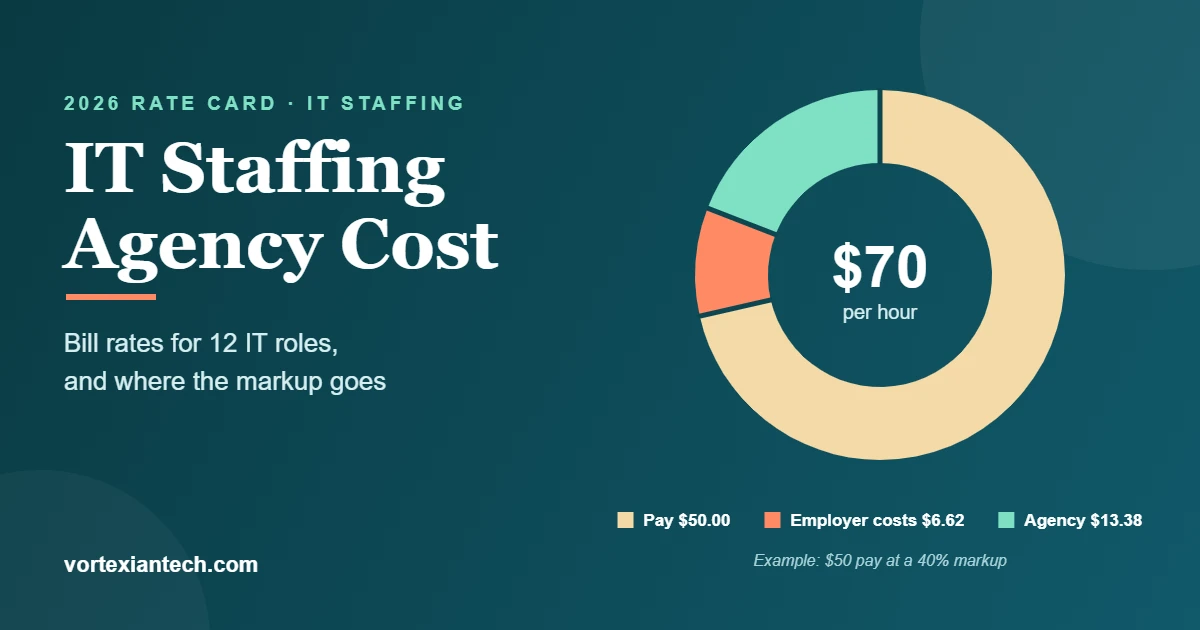
Here is where the money goes in one example: a database administrator paid $50 an hour on a six-month US contract (1,040 hours), billed at a 40% markup. The tax lines use official 2026 rates; the other amounts are made up for illustration.
Part of the $70.00 bill rate | Per hour | How it's worked out |
|---|---|---|
Contractor's pay | $50.00 | The pay rate |
Social Security and Medicare (employer share) | $3.83 | 6.2% + 1.45% = 7.65% of pay |
Federal unemployment tax (FUTA) | $0.04 | 0.6% of the first $7,000 of wages ($42), spread over 1,040 hours |
State unemployment tax and workers' comp | $0.75 | Example; rates vary by state and employer |
Benefits offered by the agency | $2.00 | Example; depends on the plan, if any |
Recruiting, account management, payroll, insurance and profit | $13.38 | What's left: 19.1% of the bill rate |
In this example, a third of the $20 markup ($6.62) goes on employer costs and benefits before the agency earns anything. The last line also has to pay the recruiter who found the person, and it carries the cost of paying the contractor every week or two while your invoice is still open. That's why a very low markup is worth questioning: something has to give, whether it's the search, the screening or the benefits.
Employer Costs Already in the Markup
When the agency employs the contractor, it pays these employer costs, and they're already inside the bill rate. Each government sets its own, which is why the same markup buys different things in different places.
Country | What the agency pays on top of pay (2026 official rates) |
|---|---|
United States | Social Security of 6.2% on pay up to $184,500 a year and Medicare of 1.45%; federal unemployment tax of 6.0% on the first $7,000, usually 0.6% after the state credit; plus state unemployment tax and workers' comp, which vary by state |
United Kingdom | Employer National Insurance of 15% on pay above £5,000 a year (2026 to 2027); a workplace pension contribution of at least 3% of qualifying earnings; paid holiday of 5.6 weeks a year for almost all workers, agency workers included |
Canada | Employer CPP contributions of 5.95% on pensionable earnings up to $74,600 (the first $3,500 is exempt), plus CPP2 above that; employer EI premiums at 1.4 times the employee rate of 1.63%, on insurable earnings up to $68,900 |
Australia | Super guarantee of 12% of qualifying earnings, paid with each payday from 1 July 2026, up to a maximum contribution base of $270,830 for 2026–27; plus state payroll tax and workers' compensation, which vary by state |
Two cases change the maths. In the UK, many IT contractors work through their own limited company. If a medium or large client decides the off-payroll working rules (IR35) apply, the deemed employer, which can be the agency, deducts income tax and employee National Insurance and pays employer National Insurance and any Apprenticeship Levy, so expect an inside-IR35 role to be priced differently from an outside one. In the US, if the person is a genuine independent contractor, the IRS says you generally don't have to withhold or pay taxes on payments to them, so no employer taxes sit inside that bill rate. Getting the classification wrong is a tax risk for whoever pays the person, so ask which kind of contract you're being quoted.
Markup or Margin? Read the Number Twice
Agencies don't all quote the same way. A markup is a percentage of the pay rate. A margin is a percentage of the bill rate. The same deal sounds smaller when it's quoted as a margin, so convert before you compare:
Markup on pay | The same deal as a margin | Bill rate on $50 pay |
|---|---|---|
25% | 20.0% | $62.50 |
40% | 28.6% | $70.00 |
50% | 33.3% | $75.00 |
75% | 42.9% | $87.50 |
The formula is margin = markup ÷ (1 + markup). UK agencies often quote margins, so a 20% margin from a UK agency is the same deal as a 25% markup from a US one. Our staffing glossary explains bill rate, markup, margin and conversion fee in plain English.
Hiring the Contractor Permanently
A good contractor often turns into someone you want on staff. What it costs to convert depends on your contract and, in some places, on the law:
United Kingdom: an agency can't enforce a transfer fee if the person starts working for you after the later of 14 weeks from their first day on the assignment or 8 weeks after their last day. Within that period, a fee can only be enforced if the contract lets you choose an extended period of hire instead.
Ontario: a temporary help agency can't stop you hiring its assignment employee, and it can generally charge a fee only during the six months that start on the person's first day working for you.
Elsewhere: the conversion clause in your agency contract usually decides the fee. Read it before the contract starts, not when you're about to make an offer.
Before you convert, compare the bill rate with the full cost of the person as your own employee, not just their salary. Our outsourcing vs in-house cost guide shows how to add that up, and our contract-to-hire guide walks through a trial and conversion week by week.
Hiring permanently from the start? Our permanent recruitment fee is a share of one month's gross salary, from 100% for fewer than 5 positions down to 50% for 40 or more, with a one-month replacement guarantee.
Check Any IT Staffing Quote in Three Steps
Get the pay rate behind the bill rate. If the agency won't share it, ask for the markup or margin instead. A bill rate on its own can't be judged.
Work out the markup. Markup = (bill rate − pay rate) ÷ pay rate. For example, a $95 bill rate for a security analyst paid $62 an hour is a 53% markup ($33 ÷ $62).
Compare, then read the terms. Check the result against the rate card and the 25% to 40% range (up to about 75% for specialist roles). Then read the conversion clause, the replacement terms and the overtime rate, and make sure employer taxes aren't added again on top of the bill rate.
Choosing between agencies, not just checking a price? Use our 12 questions to ask a recruitment agency.
Before You Sign: Quick Answers
How much does an IT staffing agency charge per hour?
It charges the contractor's pay plus a markup, which industry estimates put at about 25% to 40%, and up to about 75% for specialist roles. At BLS median pay, that is roughly $82 to $92 an hour for a software developer and $37 to $42 for a help desk specialist (example rates).
Is a 50% markup normal for IT staffing?
It's above the 25% to 40% that industry estimates give as common, but within the range for specialist, urgent or very short contracts, which can reach about 75%. Ask what the extra pays for, such as a harder search, a shorter contract or benefits for the contractor.
What is the difference between markup and margin?
A markup is a percentage of the contractor's pay; a margin is a percentage of the bill rate. A 40% markup on $50 of pay gives a $70 bill rate, which is a 28.6% margin.
Do I pay employer taxes on top of the bill rate?
Not when the agency is the contractor's employer. The agency pays the employer taxes and contributions out of the markup, so a quote that adds them as a separate line should explain why.
Can I hire an agency IT contractor directly?
Usually yes, but a conversion fee may apply. In the UK a transfer fee can't be enforced after the later of 14 weeks from the first day or 8 weeks after the last day, and in Ontario an agency can generally charge one only in the first six months.
How much does an IT contractor cost per month?
Multiply the bill rate by the hours worked. At a $70 bill rate and 160 hours, a month costs $11,200, which covers the contractor's pay and the agency's costs and margin (example).
Figures checked in November 2026. The bill rates on this page are examples worked out from official pay data, not quotes. Tax and fee rules are general information, not tax or legal advice.
Where the Pay Data and Fee Rules Come From
Pay data (BLS Occupational Outlook Handbook, May 2025 median pay): Software developers, QA analysts and testers · Web developers and digital designers · Data scientists · Database administrators and architects · Information security analysts · Network and computer systems administrators · Computer systems analysts · Computer support specialists
United States: IRS Topic 751: Social Security and Medicare withholding rates · IRS Topic 759: federal unemployment (FUTA) tax · IRS: independent contractor or employee?
United Kingdom: Rates and thresholds for employers 2026 to 2027 · Workplace pensions: what you, your employer and the government pay · Holiday entitlement · Understanding off-payroll working (IR35) · Conduct of Employment Agencies Regulations 2003, regulation 10
Canada: CRA: CPP contribution rates and maximums · CRA: EI premium rates and maximums · Ontario ESA guide: temporary help agencies
Australia: ATO: super guarantee percentage
Want a Quote You Can Check Line by Line?
Vortexian Tech's contract and temporary staffing covers contract and project staff, temporary and leave cover, contract-to-hire, and remote or on-site roles, with pay and paperwork handled. It's priced as one success-based fee per hire, based on the hire's gross monthly salary: 100% of one month's gross salary for fewer than 5 positions, 80% for 6 to 15, 75% for more than 15 and 50% for 40 or more. Every package includes sourcing, screening and a replacement within one month, and prices exclude applicable taxes.
Tell us the role, the hours and how long you need cover at info@vortexiantech.com, or book a call.