Published: 22 October 2026 · Last updated: 22 October 2026 · By Ameer Hamza
Agency pricing pages rarely show a number, so most employers only find out what a hire costs once a contract lands on their desk. This report sets out the typical 2026 market rates in the USA, UK, Canada and Australia, then works through real-world examples so you can estimate your own cost before you speak to anyone.
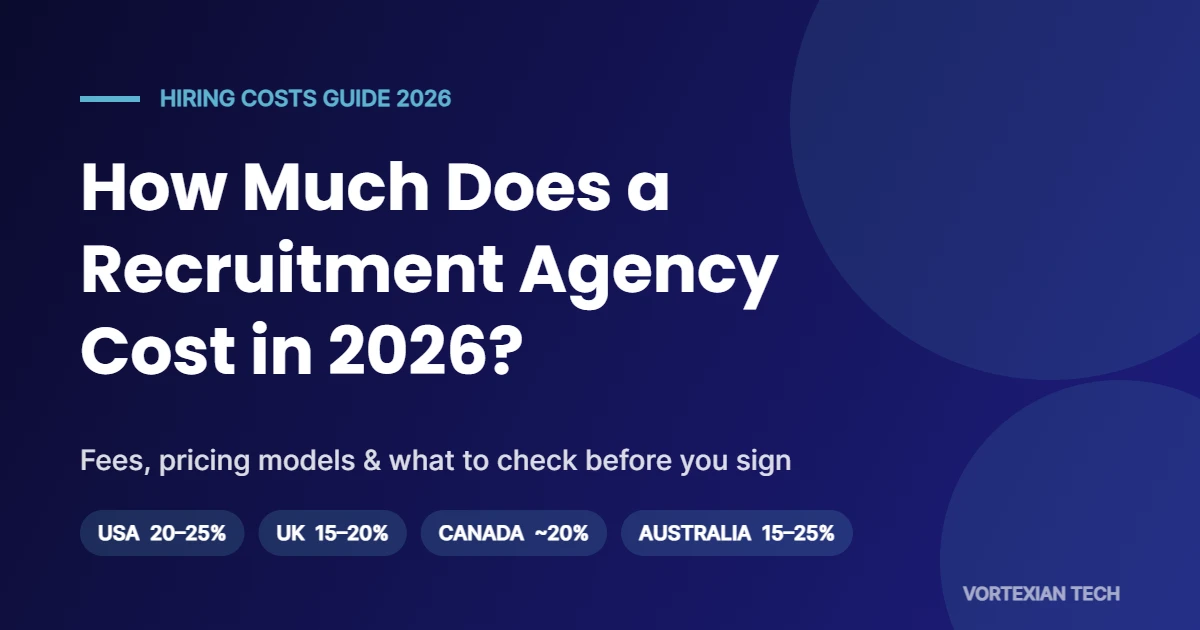
The short answer: most recruitment agencies charge 15% to 25% of a new hire's first-year salary for a permanent role, and 30% or more for senior or specialist searches. For temporary and contract workers, staffing agencies add a markup to the worker's pay instead, commonly about 25% to 40% in the USA.
The Numbers at a Glance
Country | Permanent placement fee | Senior or specialist search | Temporary and contract staff |
|---|---|---|---|
USA | 20% to 25% of salary | 30% to 35% | About 25% to 40% markup, up to 75% for specialist roles |
UK | 15% to 20% | Up to 30%; retained around 25% to 33% | About 15% to 30% margin for temps, 10% to 18% for contractors |
Canada | 15% to 30%, about 20% on average | 30% or more | Markup on pay rate, varies by province and role |
Australia | 15% to 25% | 30% to 35% | Labour hire margin on pay rate |
These are industry estimates drawn from recruitment market surveys and agency rate guides, not fixed or official prices. In Australia, check whether a quoted fee includes GST and whether it is based on base salary or a package that includes superannuation.
4 Worked Examples
These examples use the ranges above to show how the maths works. Your own quote will depend on the role and the terms you agree.
Example 1: One customer service hire in the USA
Salary $45,000 at a 20% contingency fee = $9,000, paid once the person starts. At 25%, the same hire costs $11,250.
Example 2: A temporary worker in the UK
If the worker's pay rate is £15 an hour and the agency's charge adds 25% to cover its costs and margin, you pay about £18.75 an hour, with no one-off fee. In the UK, the worker's holiday pay and employer National Insurance are usually built into the charge rate, so ask for a breakdown.
Example 3: Ten warehouse hires in Australia
Ten roles at A$60,000 each at a 15% fee = A$9,000 per hire, or A$90,000 in total. At this volume, a per-hire or RPO arrangement is often negotiated lower, which is why bulk hiring is usually priced differently from one-off searches.
Example 4: A senior hire in Canada
A C$120,000 role on a 25% retained search = C$30,000, often paid in three stages of C$10,000: at engagement, at shortlist and at placement.
Pricing Models Compared
Model | How you pay | Typical rate | Best for |
|---|---|---|---|
Contingency | Only if you hire the agency's candidate | 15% to 25% of first-year salary | Junior to mid-level permanent roles |
Retained search | In stages, part upfront | About 25% to 33%, higher in niche fields | Senior, confidential or hard-to-fill roles |
Flat fee | Fixed price per role | Agreed upfront | Several similar roles, easy budgeting |
RPO or per hire | Monthly fee, cost per hire, or both | Quoted by volume | Ongoing or high-volume hiring |
Temp or contract markup | Hourly, weekly or monthly rate | Pay rate plus markup | |
Fixed-term contract (UK) | One-off fee | Often 12% to 15% of the equivalent annual salary | Maternity cover and fixed projects |
What Hiring Costs Without an Agency
Doing it yourself is not free. Widely cited benchmarks put the average cost per hire at around $4,700 in the USA and about £3,000 in the UK, where the average time to hire is close to a month. Those figures cover job ads, recruiter and manager time, screening and interviews, but not the cost of a bad hire, which is often estimated at up to 30% of the person's first-year salary. Good candidate screening and assessment is what keeps that risk down, whoever does the hiring.
Beyond Recruitment: Typical HR and Outsourcing Costs
Service | Typical market price |
|---|---|
$5 to $15 per employee per month, plus a $100 to $500 base fee | |
Employer of record or manpower outsourcing | $99 to $999 per employee per month, or 5% to 25% of salary |
$1,500 to $4,000 per full-time person per month | |
$3,000 to $8,000 per project | |
$5,000 to $15,000 | |
$5,000 to $20,000, by company size | |
HR consultant | $75 to $375 per hour |
Negotiation Playbook: 6 Ways to Pay Less
Offer exclusivity for a set period in return for a lower percentage.
Bundle roles with one partner and ask for a volume rate or flat fee.
Ask for a flat fee on higher-paid roles, where a percentage grows quickly.
Write a tight brief with must-have skills, salary range and start date, so the search is faster and cheaper to run.
Give feedback within 48 hours on every shortlist. Slow decisions lose candidates and drag the search out.
Consider remote and international recruitment for roles that don't need to be on site.
Contract Red Lines to Check
Replacement guarantee or rebate: how long it lasts (often 3 to 6 months in Australia, commonly 60 to 90 days elsewhere) and whether you get a replacement or a refund. In the UK, agencies may offer a rebate but don't have to, so get it in writing.
Fee base: base salary only, or salary plus bonus, allowances or superannuation.
Temp-to-perm fees: what it costs to hire a temporary worker permanently.
Payment terms and extras: when the fee is due, and whether ads, tests or background checks cost extra.
For a plain-English comparison of the two agency types, read staffing agency vs recruitment agency.
Frequently Asked Questions
How much does a recruitment agency charge?
Most agencies charge 15% to 25% of the new hire's first-year salary for a permanent role. Senior or specialist searches can cost 30% to 35%.
Who pays the recruitment agency fee?
The employer pays. Reputable agencies do not charge candidates for finding them a job.
When is the recruitment fee paid?
For contingency placements, usually when the new hire starts. For retained searches, in stages agreed at the start.
What is a typical staffing agency markup?
In the USA, about 25% to 40% on the worker's pay rate, and up to 75% for specialist roles. UK temporary margins are commonly 15% to 30%.
Can recruitment agency fees be negotiated?
Yes. Exclusivity, volume, flat-fee pricing and faster payment terms are the most common ways to agree a lower rate.
What happens if the new hire leaves early?
Most agencies offer a replacement guarantee or a partial rebate if the person leaves within the agreed period. Check the exact terms before you sign.
Is it cheaper to hire without an agency?
Not always. Doing it in-house still costs money and time, around $4,700 per hire in the USA and about £3,000 in the UK on common estimates, and you carry the full risk of a bad hire.
Are recruitment fees different in the USA, UK, Canada and Australia?
Yes. US fees tend to be highest at about 20% to 25%, the UK is often 15% to 20%, Canada averages about 20%, and Australia is usually 15% to 25%.
Sources and Further Reading
The Conduct of Employment Agencies and Employment Businesses Regulations 2003 (legislation.gov.uk)
Temporary help agencies, Your guide to the Employment Standards Act (Government of Ontario)
Labour Hire Authority (Victoria State Government)
Labour hire licensing (Queensland Government)
GST: Goods and Services Tax (Australian Taxation Office)
Super for employers (Australian Taxation Office)
Fee and cost figures in this article are industry estimates and change over time. The official sources above cover the legal and tax rules mentioned. This article is general information, not legal or financial advice.
Get a Written Quote
Vortexian Tech helps businesses in the USA, UK, Canada and Australia hire permanent staff, run bulk hiring, supply contract and temporary workers, and outsource payroll and HR. Tell us the roles you need to fill and we will send a clear, written quote with no hidden fees, or see our case studies first.