Published: 25 November 2026 · Last updated: 25 November 2026 · By Ameer Hamza
Many assessment days go wrong before a single candidate walks in. The room is booked and the exercises are printed, but the assessors never agreed what "good" looks like, so each one scores on gut feel. By lunchtime you have 24 tired candidates and four sets of notes nobody can compare.
An assessment day (often called an assessment centre) is a half-day or full-day session where a group of candidates completes group exercises, work samples, tests and interviews, all scored by trained assessors against the same criteria. It is built for volume hiring: instead of 24 separate interviews, you watch 24 people do the actual work in one session.
When an Assessment Day Is Worth It
You are filling several places in the same role, such as a customer service team, a warehouse shift or a graduate intake.
The skills are easier to watch than to describe: handling a customer, working in a team, getting details right.
One-to-one interviews would take your managers weeks.
For a single senior hire, a structured interview process usually works better. For really large intakes, our high-volume hiring guide shows how many people to invite at each stage.
The Run Sheet
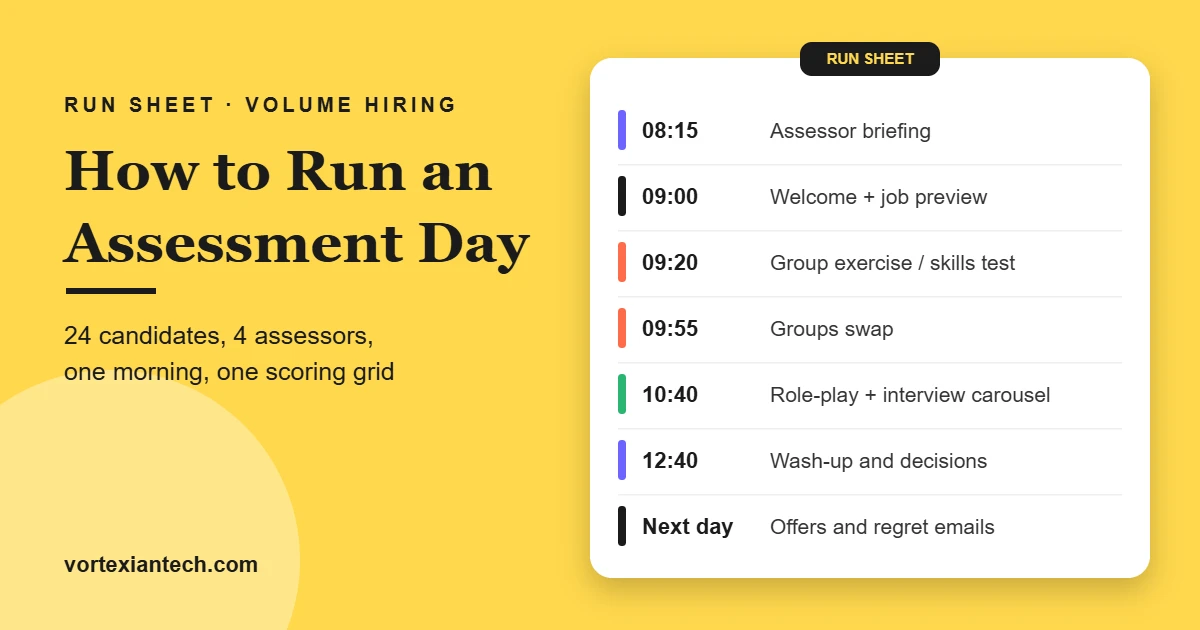
Here is an example timetable for 24 candidates applying for 8 customer service roles, with 4 assessors and 1 coordinator. Swap in your own exercises, but keep the structure.
Time | Block | Candidates | Assessors |
|---|---|---|---|
08:15–08:45 | Assessor briefing: scoring grid, rating scale, one practice rating | — | All 4 |
09:00–09:20 | Welcome, confirm adjustments, realistic preview of the job | All 24 | All 4 |
09:20–09:50 | Rotation 1: group A does the group exercise, group B does the skills test | 12 + 12 | 4 on the group exercise, 3 candidates each |
09:55–10:25 | Rotation 2: groups swap | 12 + 12 | 4 on the group exercise, 3 candidates each |
10:25–10:40 | Break; assessors finish their notes before talking | All 24 | All 4 |
10:40–12:40 | Carousel: 20-minute slot per candidate with an 8-minute customer call role-play and a 12-minute structured interview | 6 per assessor | All 4 |
12:40–13:40 | Wash-up: compare scores, decide who meets the bar | — | All 4 |
Next working day | Offers and regret emails go out | All 24 | Coordinator |
The coordinator runs the skills test room, the clock and the waiting area, so assessors only assess. Candidates waiting for their carousel slot can meet team members and ask questions, which also helps them decide if the job suits them.
What it costs in time, using this example: 4 assessors from 08:15 to 13:40 is about 22 assessor hours. Interviewing the same 24 people one by one, with two interviewers for 45 minutes each, would take 36 interviewer hours, and you would only hear about the work instead of seeing it.
The Scoring Grid
Score each skill in at least two exercises, so one bad moment can't sink a good candidate or one good answer carry a weak one.
Skill | Group exercise | Skills test | Role-play | Interview |
|---|---|---|---|---|
Communication | ✓ | — | ✓ | ✓ |
Customer focus | — | — | ✓ | ✓ |
Accuracy | — | ✓ | ✓ | — |
Teamwork | ✓ | — | — | ✓ |
Problem solving | ✓ | ✓ | — | — |
Use a 1 to 4 scale with a short description of what each number looks like ("4: calms the customer, solves the problem and confirms next steps"). Assessors score on their own first and only then discuss. Agree the bar before the day, for example "no score below 2 and an average of at least 3".
Fairness Checks Before and After the Day
Keep every exercise job-related. The EEOC says a test that screens out a protected group more than others must be job-related and consistent with business necessity, and lists work samples and simulations among the selection procedures this covers. A role-play built from real customer calls is easy to defend; a general puzzle is not.
Offer adjustments up front. US employers must provide reasonable accommodation in the way tests are given, unless it would cause undue hardship, so results reflect the skill and not a disability. UK guidance lists changing the recruitment process as one example of a reasonable adjustment. Ask every candidate the same question in the invitation; our hiring email templates include the wording.
Never adjust scores by group. Under Title VII, employers may not change scores or use different cut-offs based on race, color, religion, sex or national origin.
Run the four-fifths check afterwards. US enforcement agencies use a rule of thumb: if a group's selection rate is below 80% of the rate for the group with the highest rate, that is a sign of adverse impact. For example, if 7 of 14 candidates in one group get offers (50%) but only 3 of 10 in another (30%), the ratio is 30 ÷ 50 = 60%, well under 80%. Find out which exercise caused the gap before your next assessment day.
Six Ways Assessment Days Go Wrong
No calibration. Assessors who never practise a rating together drift apart within the first hour.
Too many candidates per assessor. Watching six people in a group discussion means missing most of what they do. Plan for two or three each.
Exercises that test the wrong thing. If the job is answering customer emails, test that, not public speaking.
Long, empty waits. Candidates judge you too. Give them something useful to do between blocks.
Adjustments as an afterthought. Asking on the day is too late to arrange extra time or a different format.
Slow decisions. If offers take a week, your best candidates may accept other jobs first. Decide in the wash-up and send emails the next working day.
Assessment Day Questions
Is an assessment day the same as an assessment centre?
In practice, yes. "Assessment centre" usually means the method of using several exercises and assessors, and "assessment day" means the event where it happens.
Can an assessment day be run online?
Yes. Group exercises can run in video breakout rooms and tests can be taken online. Keep the same scoring grid, check that every tool works with screen readers and other assistive technology, and allow for time zones.
How many candidates should I invite for each role?
In this example, 3 candidates for every place (24 for 8 roles). Invite more if your screening is light or many people drop out, and fewer if candidates are already strongly screened.
The timetable and figures in this guide are an illustrative example, not a client case. Adjust them to your roles and numbers. This is general information, not legal advice.
Rules Behind the Fairness Checks
Employment tests and selection procedures (U.S. Equal Employment Opportunity Commission)
Questions and answers on the Uniform Guidelines on Employee Selection Procedures (U.S. Equal Employment Opportunity Commission)
Reasonable adjustments for workers with disabilities or health conditions (GOV.UK)
Let Us Run Your Next Hiring Day
Vortexian Tech's bulk hiring service covers high-volume sourcing, group and fast-track screening, assessment days and coordinated onboarding. Packages run from 100% of one month's gross salary per hire for fewer than 5 positions down to 50% for 40 or more, each with a one-month replacement. Need tests or interviews only? Our candidate screening and assessment team adds structured interviews and skills and aptitude tests.
Tell us the role, the number of places and your start date at info@vortexiantech.com, or book a call.