Published: 25 November 2026 · Last updated: 25 November 2026 · By Ameer Hamza
How long should a former employee's file stay in your cabinet? Many managers would say "forever, to be safe". That answer fails twice: some records have legal minimums you can't cut short, and privacy law expects you to delete what you no longer need. The right answer is a schedule, with a clock for each type of record.
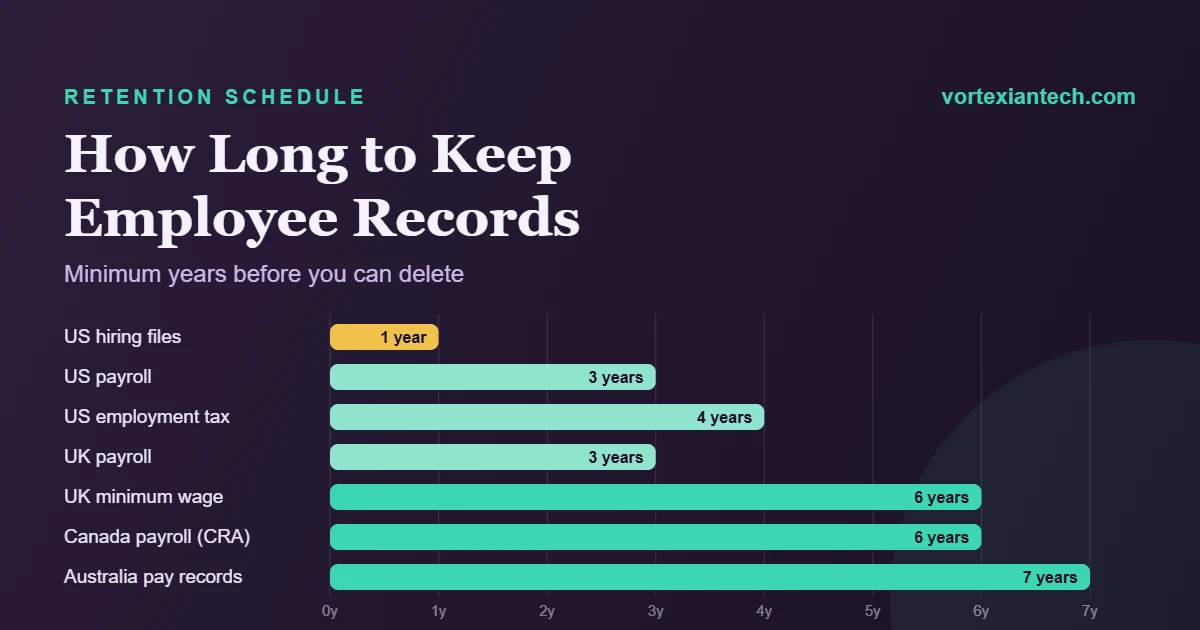
Short version: keep payroll records for at least 3 years in the US (employment tax records 4), 3 years after the tax year in the UK (6 for minimum wage records), 6 years after the tax year in Canada and 7 years in Australia. Hiring files, Form I-9s, right to work copies and safety logs each run on their own clock.
The Retention Schedule
These are legal minimums from each government's own guidance (links at the end). Where two rules cover the same record, follow the longer one.
Country | Record | Keep for at least | Clock starts |
|---|---|---|---|
United States | Hiring and personnel records | 1 year | From the record or decision; from the termination date if someone was let go |
United States | Payroll records | 3 years | From the record |
United States | Time cards, wage rate tables, work schedules | 2 years | From the record |
United States | Employment tax records | 4 years | After you file the fourth-quarter return for the year |
United States | Form I-9 | 3 years after hire or 1 year after employment ends, whichever is later | Hire date and last day |
United States | OSHA injury and illness logs (300, 300A, 301) | 5 years | After the end of the calendar year they cover |
United Kingdom | PAYE payroll records | 3 years | From the end of the tax year they relate to |
United Kingdom | National Minimum Wage records | 6 years | For records created on or after 1 April 2021 |
United Kingdom | Right to work check copies | The whole employment, plus 2 years | From the day the person stops working for you |
Canada | Payroll and tax records (CRA) | 6 years | From the end of the last tax year they relate to |
Canada (Ontario) | Hours, wage statements, leave documents | 3 years | From the work day or week, the statement, or the end of the leave |
Canada (Ontario) | Vacation time and vacation pay records | 5 years | From when the record was made |
Australia | Employee records: hours, pay, leave, super | 7 years | From when the record was made |
Australia | Tax and super records (ATO) | 5 years | From when prepared or obtained, or the transaction finished, whichever is later |
US states and Canadian provinces can set longer periods than these national rules, so check each place where you employ people.
Worked Dates: When Can You Actually Delete?
The clock is where most mistakes happen. These examples apply the rules above to made-up dates:
Example | Rule applied | Keep until |
|---|---|---|
US employee hired 2 March 2023, left 30 June 2026 | I-9: later of 2 March 2026 (3 years after hire) and 30 June 2027 (1 year after leaving) | 30 June 2027 |
US employee hired 1 February 2026, left 31 May 2026 | I-9: later of 1 February 2029 and 31 May 2027 | 1 February 2029 |
UK payroll for the 2025 to 2026 tax year (ends 5 April 2026) | PAYE: 3 years from the end of the tax year | 5 April 2029 |
UK employee who leaves on 31 August 2026 | Right to work copies: 2 years after leaving | 31 August 2028 |
Canadian payroll records for 2026 | CRA: 6 years from the end of the tax year | 31 December 2032 |
Australian pay record made on 15 March 2026 | Fair Work: 7 years | 15 March 2033 |
Notice the second example: a short stint can mean a longer wait, because the 3-years-after-hire limit outlasts the 1-year-after-leaving limit.
When to Keep Records Longer
A discrimination charge or lawsuit. The EEOC says records related to a charge must be kept until the charge, and any lawsuit based on it, is finally resolved.
Certain US tax credits. The IRS asks employers to keep records for qualified sick and family leave wages and employee retention credit wages for at least 6 years.
An open claim or dispute. Don't destroy anything linked to a complaint, audit or claim until it is closed, even if its normal period has run out.
When to Delete
Keeping everything "just in case" is a risk of its own. The UK GDPR doesn't set fixed periods for most personal data, but it does say data must not be kept longer than necessary. The ICO expects organisations to set standard retention periods, ideally in a written retention policy, and to delete or anonymise what they no longer need. Right to work copies are a good example: after 2 years from the end of employment, the reason to hold them has gone.
Build Your Own Retention Policy
A usable policy fits on one page. For each type of record, write down five things:
Record type: for example, payroll, personnel file, I-9, timesheets.
Owner: the person who keeps it and signs off on deletion.
Trigger: the event that starts the clock, such as hire date, last day or end of tax year.
Period: the longest legal minimum that applies, from the schedule above.
Deletion method: shredding, secure deletion or anonymising, and who checks it was done.
Add it to your employee handbook so managers can find it. Our employee handbook checklist shows where it fits, and if payroll records are the messy part, our payroll switch plan covers what to hand over.
Record-Keeping Questions
Do retention periods start when an employee leaves?
Only for some records. Form I-9 and UK right to work copies count from the end of employment, payroll records usually count from the tax year, and Ontario hours records count from the day or week worked. Use the clock in the schedule for each record.
How long should I keep applications from people I didn't hire?
In the US, the EEOC requires personnel and employment records, including hiring records, to be kept for 1 year. In the UK there is no fixed period, so set one in your privacy notice and keep the data no longer than you need it.
Can I keep employee records electronically?
Yes, as long as they stay complete and easy to produce. Fair Work, for example, says records must be legible, in English and readily accessible to an inspector, and the CRA asks businesses to keep the records their computer systems create.
What happens if payroll records are missing?
Penalties vary by country. In the UK, HMRC says it may estimate what you owe and charge a penalty of up to £3,000 if your payroll records are incomplete.
This schedule reflects official guidance checked in November 2026. It is general information, not legal advice. Check the rules for each place you employ people before you destroy records.
Official Record-Keeping Rules
United States: EEOC recordkeeping requirements · DOL Fact Sheet 21: recordkeeping under the FLSA · USCIS M-274, 10.0: retaining Form I-9 · IRS employment tax recordkeeping · 29 CFR 1904.33: OSHA record retention (eCFR)
United Kingdom: PAYE: keeping records · Employers and the minimum wage · Check a job applicant's right to work · ICO: storage limitation
Canada: CRA: keeping records · Ontario ESA guide: record keeping
Australia: Fair Work: record-keeping and pay slips · ATO: employment and payroll records
Get Your Records in Order
If your personnel files have grown without a plan, Vortexian Tech can sort them out. Our HR compliance audit covers personnel files, retention and employee data handling, and our contracts and records review shows what to keep, fix or delete. Our HR policies and handbook packages start at $1,800 one-time, and our payroll outsourcing team can take over payroll records going forward.
Send us your record types and where you employ people at info@vortexiantech.com, or book a call.