Published: 11 November 2026 · Last updated: 11 November 2026 · By Ameer Hamza
Retail had almost 700,000 open jobs in September 2026. It is still not one of the hard places to hire. In the same month, retailers hired slightly more people than they had openings. Finance and insurance had well under half as many openings, yet each one was far harder to fill.
That gap is the point of this study. A big openings number tells you demand is high. It does not tell you whether employers are keeping up. To see that, you have to compare openings with hires.
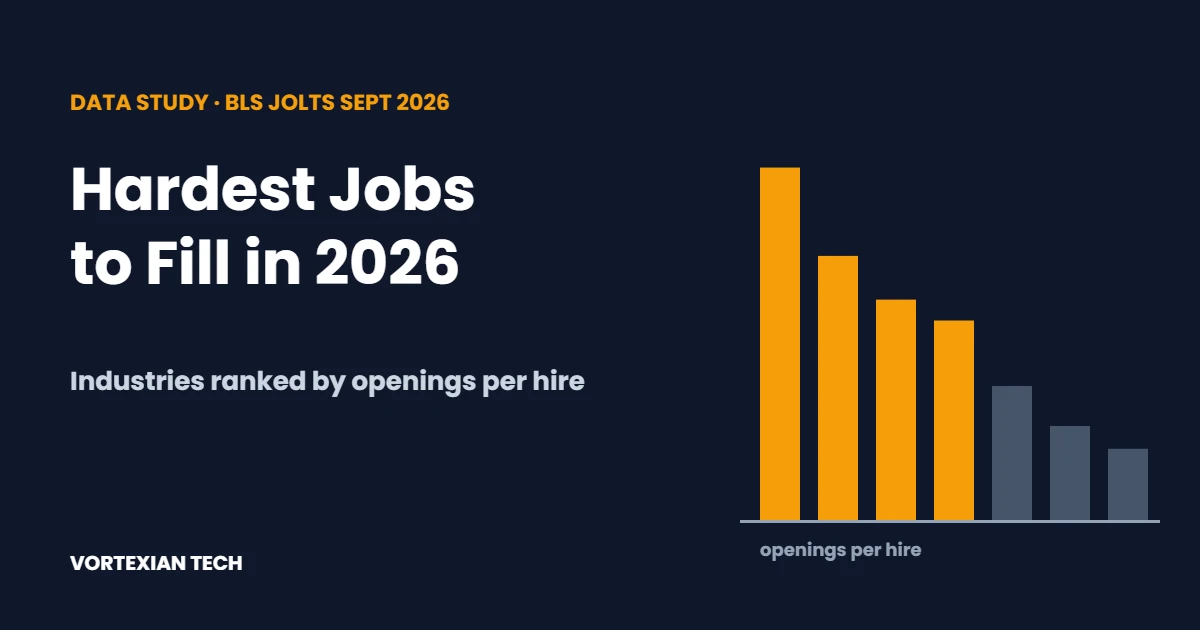
Key finding: in the latest official US data (BLS JOLTS, September 2026), the private industries with the most job openings per monthly hire were finance and insurance (2.78), durable goods manufacturing (2.32) and health care and social assistance (2.10). Across all private industries the figure was 1.31. Restaurants, hotels, retail and construction were below 1.0, which means hiring kept pace with openings.
How we measured "hard to fill"
The Bureau of Labor Statistics publishes the Job Openings and Labor Turnover Survey (JOLTS) every month. Two of its numbers matter here:
- Job openings: every position open on the last business day of the month. It is a one-day snapshot.
- Hires: everyone added to payroll during the whole month.
We divided the first by the second for each industry. We call the result openings per hire. It is our own calculation, not an official BLS measure. Read it as a rough backlog: if an industry has 2 openings for every person it hires in a month, it would take about two months of hiring at the current pace to fill today's open roles, even if no new jobs opened.
We also divided quits by hires. That shows how much of an industry's hiring simply replaces people who walked out.
All figures are seasonally adjusted, in thousands, for September 2026 (preliminary), from the release published on 3 November 2026.
The ranking: private industries by openings per hire
| Industry | Openings | Hires | Openings per hire | Quits as % of hires |
|---|---|---|---|---|
| Finance and insurance | 289 | 104 | 2.78 | 59% |
| Durable goods manufacturing | 403 | 174 | 2.32 | 61% |
| Health care and social assistance | 1,479 | 705 | 2.10 | 68% |
| Private educational services | 135 | 93 | 1.45 | 69% |
| Real estate and rental and leasing | 75 | 52 | 1.44 | 69% |
| Professional and business services | 1,310 | 927 | 1.41 | 50% |
| Wholesale trade | 225 | 169 | 1.33 | 66% |
| Mining and logging | 26 | 20 | 1.30 | 70% |
| Nondurable goods manufacturing | 180 | 139 | 1.29 | 65% |
| Other services | 270 | 211 | 1.28 | 64% |
| Transportation, warehousing and utilities | 360 | 290 | 1.24 | 55% |
| Information | 116 | 94 | 1.23 | 41% |
| Retail trade | 698 | 704 | 0.99 | 67% |
| Construction | 298 | 356 | 0.84 | 56% |
| Accommodation and food services | 659 | 879 | 0.75 | 82% |
| Arts, entertainment and recreation | 120 | 162 | 0.74 | 20% |
| All private industries | 6,644 | 5,078 | 1.31 | 63% |
Openings and hires in thousands. Ratios are our calculations from BLS JOLTS Tables 1, 2 and 4.
Government sits even higher than any private industry (federal 3.71, state and local excluding education 3.46), but public hiring runs on its own rules and timelines, so we left it out of the ranking.
Three patterns behind the numbers
1. Slow-fill industries hire for credentials, not just headcount
The top three share one trait: many roles need a licence, a certification or a specific track record. A bank cannot hire any good communicator as a compliance analyst. A hospital cannot move a nurse's start date until the credential checks are done. A factory making machinery needs people who can read drawings and run particular equipment. The pool is smaller, checks take longer, and good candidates often have several offers.
2. Health care has the biggest backlog by far
By ratio, finance is first. By size, nothing comes close to health care and social assistance: 1,479,000 open roles against 705,000 hires in the month. That is about 774,000 more openings than hires, twice the gap in professional and business services (383,000), the next biggest. It also has a high quit share: about two in three hires replace someone who quit.
3. Huge openings can still mean easy hiring
Restaurants and hotels hired 879,000 people in September against 659,000 openings. The catch is the last column: 82% of those hires replaced people who quit, the highest share in the table. For these employers the problem is not finding people. It is keeping them. If that sounds familiar, our employee turnover cost guide shows what that churn costs and how to bring it down.
Hiring in one of the top three? Tell us the role, location and start date. We will tell you honestly how hard it looks and send a written quote. info@vortexiantech.com or request a quote.
What to do if your industry is at the top of the list
A ratio above 2 means the normal "post an ad and wait" approach will lose candidates to faster employers. These moves help:
- Start sourcing before the role is approved. If it usually takes two months to fill, open the search when you know someone is leaving, not on their last day.
- Cut the steps, not the checks. Keep credential and reference checks, but put interviews in one week instead of three. In slow-fill markets, the best candidates are gone in days.
- Rewrite the ad around the job, not a wish list. Separate must-have credentials from nice-to-haves. Our job description rewrite example shows how much this widens the pool.
- Go to candidates who are not applying. In tight fields most qualified people already have jobs. Direct outreach and referrals reach them; job boards often do not. This is the core of our recruitment service.
- Use a bridge while you search. A contract or temporary professional keeps work moving. Contract staffing or a contract-to-hire trial can cover the gap and sometimes becomes the permanent hire.
- Look beyond your city for roles that can be remote. Back-office finance, billing, medical coding support and scheduling often do not need to be on site. Remote staffing widens the pool for those roles.
And if you sit at the bottom of the table, with fast hiring but high quits, your money is better spent on retention than on more recruiting. When you need many people at once anyway, our high-volume hiring guide and bulk hiring service cover that case.
Limits of this analysis
- It is one month of preliminary data. BLS revises figures, and seasonal patterns can shift the ranking from month to month.
- Industry averages hide big differences between roles. A hospital may fill porters quickly and specialist nurses slowly.
- Openings are counted on one day and hires over a whole month, so the ratio is an indicator, not an exact time-to-fill.
- JOLTS covers the United States only.
Questions employers ask about this data
What are the hardest jobs to fill in 2026?
By openings per hire in the September 2026 JOLTS data, the hardest private industries were finance and insurance (2.78), durable goods manufacturing (2.32) and health care and social assistance (2.10). Health care had the largest number of unfilled roles.
Does a high number of job openings mean a talent shortage?
Not on its own. Retail and restaurants have very high openings but also very high hires. Compare openings with hires: when openings are well above monthly hires, roles are staying open longer.
How often is JOLTS data released?
Monthly. Each release covers the month about five weeks earlier, and the previous month is revised. You can rerun this calculation with every new release using BLS Tables 1 and 2.
How can a small business compete for hard-to-fill roles?
Move faster than larger employers, write a clear job ad with true must-haves, reach passive candidates through outreach and referrals, and consider contract or remote options while the permanent search runs.
Where the numbers come from
- BLS: Job Openings and Labor Turnover Summary (September 2026)
- BLS: JOLTS Table 1, Job openings by industry
- BLS: JOLTS Table 2, Hires by industry
- BLS: JOLTS Table 4, Quits by industry
Have a role that has been open too long?
Send us the job title, location and how long it has been open. We will reply with what we would change in the search and a written quote. Our recruitment packages are priced at 50% to 100% of one month's gross salary for the role, and include a replacement if the hire leaves within the first month.
Email info@vortexiantech.com or request a quote here.